---
## What is it?
MediaStationGo is a self-hosted media center for personal libraries, home NAS, and home-theater users.
It helps you:
- Manage movies, TV shows, anime, variety shows, music, and adult libraries.
- Create multiple user accounts for family members, friends, or different devices.
- Scan files and enrich posters, summaries, years, seasons, and episodes.
- Play in the web UI, or log in with a MediaStationGo account from Emby-protocol apps such as Infuse, VidHub, SenPlayer, and Emby clients.
- Connect qBittorrent for search, subscriptions, downloads, and post-download organization.
- Connect OpenList, CloudDrive2, WebDAV, and other storage backends with STRMURL or 302 redirect playback.
- Run on NAS, mini PCs, VPS, Linux, Windows Docker Desktop, or any Docker-friendly host.
> The project is moving fast. Keep a backup of the `data` directory before upgrades.
---
## Key Highlights
- **One server, many clients**: deploy MediaStationGo once; you do not need to run a separate Emby server.
- **Emby-protocol compatibility**: add the server in third-party players as an Emby/Jellyfin-compatible server, then log in with your MediaStationGo username and password.
- **Multi-user management**: supports admins, regular users, account enable/disable, expiry dates, device management, Bot registration, and redeem codes.
- **Local + cloud media in one place**: manage local disks, download folders, OpenList, CloudDrive2, WebDAV, and other storage backends from one panel.
- **Download-to-library workflow**: connect qBittorrent for search, subscriptions, download completion organization, and metadata matching.
- **NAS-friendly**: simple Docker Compose deployment, important data stored under `data/`, suitable for low-power NAS and mini PCs.
---
## Who is it for?
- **Beginners** who want to edit one `docker-compose.yml` and start the service.
- **NAS users** who want a low-resource media center for local disks and cloud storage.
- **PT/download users** who want downloads, organization, metadata, and playback in one panel.
- **External-player users** who want to log in to Emby-protocol third-party apps with one MediaStationGo account.
- **Family-sharing users** who want separate user accounts without deploying a separate media server for each person.
- **Developers** who want to study or extend a Go + React self-hosted media app.
---
## Live Demo
- URL: [https://mgo.3jzs.com](https://mgo.3jzs.com)
- Username: `admin`
- Password: `admin123`
> The demo is for feature preview only. Do not save private API keys, tracker cookies, or personal data there.
---
## Quick Start
Docker Compose is the recommended path. Beginners do not need `.env`, bare-metal binaries, or source builds.
```bash
mkdir -p MediaStationGo
cd MediaStationGo
curl -fsSL https://raw.githubusercontent.com/ShukeBta/MediaStationGo/main/docker-compose.yml -o docker-compose.yml
```
Edit `docker-compose.yml`:
```bash
vi docker-compose.yml
```
Start:
```bash
docker compose up -d
```
Open:
```text
http://SERVER_IP:18080
```
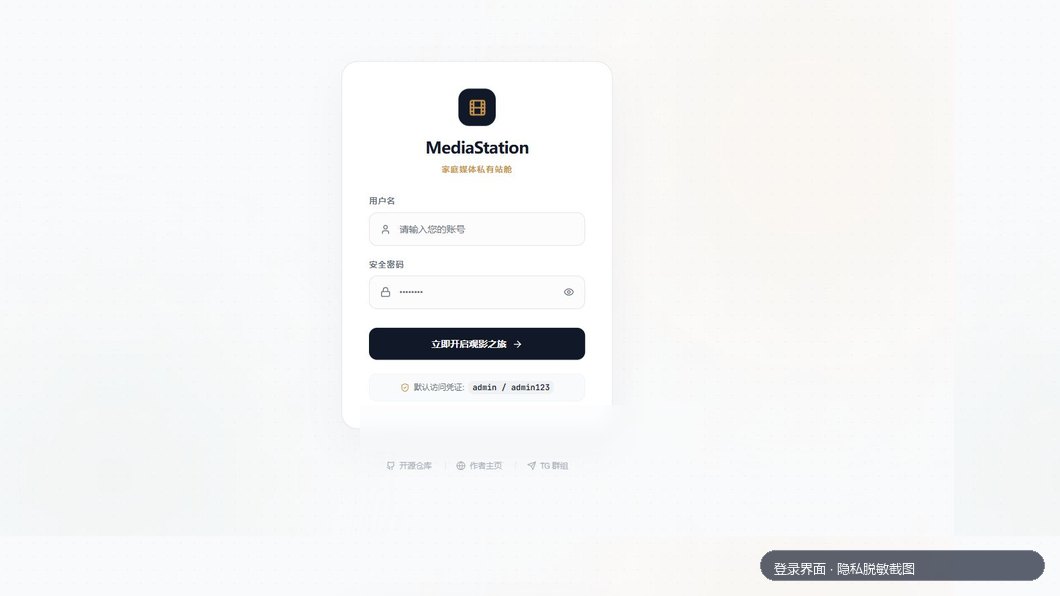
Default login:
```text
Username: admin
Password: admin123
```
---
## Docker Compose Recommended
The repository `docker-compose.yml` is the lightweight recommended template: no `.env` required, and by default it only starts `MediaStationGo + PostgreSQL`. This is the best starting point for most NAS users.
If you already have an older `./data/mediastation.db`, the first start with the new compose file automatically imports it into PostgreSQL. Keep `./data`; it still stores the JWT secret, runtime data, and the old SQLite migration source.
### Three deployment modes
| Mode | Command | Best for |
| --- | --- | --- |
| Lightweight: PG only | `docker compose up -d` | Most NAS devices, lowest resource use |
| Standard: PG + Redis | `docker compose -f docker-compose.yml -f docker-compose.standard.yml up -d` | Multi-user use and frequent Emby client refreshes |
| Search enhanced: PG + Redis + OpenSearch | `docker compose -f docker-compose.yml -f docker-compose.standard.yml -f docker-compose.search.yml up -d` | Huge libraries and future standalone search indexing |
Start with the lightweight mode. Redis and OpenSearch are enhancement layers, not source databases. Do not enable OpenSearch by default on low-memory NAS devices.
### Choose an image source
Both image sources are supported. Pick one and put it in `image:`:
| Source | Image | Best for |
| --- | --- | --- |
| GitHub Container Registry (GHCR) | `ghcr.io/shukebta/mediastation-go:latest` | Recommended default, follows repository releases |
| Docker Hub | `shukbet/mediastationgo:latest` | Backup source when GHCR is slow or unavailable |
To pin a version, first confirm the tag exists on the repository Packages page. Use this format:
```yaml
image: ghcr.io/shukebta/mediastation-go:
# If GHCR does not have that tag, use Docker Hub as the backup:
# image: shukbet/mediastationgo:MediaStationGo-v0.0.72
```
For the simplest setup, keep GHCR `latest`.
Manual pull examples:
```bash
# GitHub Container Registry
docker pull ghcr.io/shukebta/mediastation-go:latest
# Docker Hub backup
docker pull shukbet/mediastationgo:latest
```
Focus on this part:
```yaml
volumes:
- ./data:/data
- ./cache:/cache
- ./media:/media
- ./downloads:/downloads
```
Meaning:
| Host path | Container path | Purpose |
| --- | --- | --- |
| `./data` | app `/data` | Settings, JWT secret, old SQLite migration source; back this up |
| `./cache` | app `/cache` | Cache; safe to clean when needed |
| `./media` | `/media` | Media libraries; use `/media/...` in the web UI |
| `./downloads` | `/downloads` | Download directory and organization source |
| `./postgres` | PostgreSQL `/var/lib/postgresql/data` | New default primary database; back this up |
| `./redis` | Redis `/data` | Used only in standard mode; hot cache, rebuildable |
| `./opensearch` | OpenSearch `/usr/share/opensearch/data` | Used only in search-enhanced mode; higher memory use |
If your NAS paths are:
```text
/vol1/1000/Media
/vol1/1000/Downloads
```
change the compose file to:
```yaml
volumes:
- ./data:/data
- ./cache:/cache
- /vol1/1000/Media:/media
- /vol1/1000/Downloads:/downloads
environment:
MEDIASTATION_MEDIA_DIR: /vol1/1000/Media
MEDIASTATION_DOWNLOAD_DIR: /vol1/1000/Downloads
```
Rules:
- The left side of `volumes` is the real path on your host/NAS.
- The right side is the container path. Keep `/media` and `/downloads` unless you know why you are changing them.
- In the web UI, create libraries with container paths such as `/media/Movies` or `/media/TV`.
- Do not write NAS absolute paths as `./vol1/...`; `./` means a folder under the current compose directory.
- On Windows Docker Desktop, paths like `D:/Media:/media` and `D:/Downloads:/downloads` are fine.
- If you only scan/play existing media and never organize into the library, you may add `:ro`; if you use organize/rename/ingest, the media mount must stay writable.
### Minimal compose example
The root `docker-compose.yml` follows this style:
```yaml
services:
mediastation-go:
# Pick one image source:
# GitHub Container Registry (GHCR):
image: ghcr.io/shukebta/mediastation-go:latest
# Docker Hub backup:
# image: shukbet/mediastationgo:latest
container_name: mediastation-go
restart: unless-stopped
init: true
depends_on:
postgres:
condition: service_healthy
# Browser: http://SERVER_IP:18080
ports:
- "18080:8080"
# Let the container reach qBittorrent running on the host:
# qB URL example: http://host.docker.internal:8085
extra_hosts:
- "host.docker.internal:host-gateway"
volumes:
# Application data. Back this up before upgrades.
- ./data:/data
- ./cache:/cache
# Beginners can keep ./media and ./downloads.
# NAS users should replace the left side with real absolute paths.
- ./media:/media
- ./downloads:/downloads
environment:
TZ: Asia/Shanghai
PUID: "1000"
PGID: "1000"
MEDIASTATION_APP_HOST: 0.0.0.0
MEDIASTATION_APP_PORT: 8080
MEDIASTATION_APP_WEB_DIR: /app/web/dist
MEDIASTATION_APP_DATA_DIR: /data
# Lightweight mode uses PostgreSQL by default.
# Old SQLite data migrates from this path on first start.
MEDIASTATION_DATABASE_TYPE: postgres
MEDIASTATION_DATABASE_DSN: postgres://mediastation:mediastation@postgres:5432/mediastation?sslmode=disable
MEDIASTATION_DATABASE_DB_PATH: /data/mediastation.db
MEDIASTATION_CACHE_CACHE_DIR: /cache
# If you changed ./media or ./downloads above,
# set these to the same real host paths.
MEDIASTATION_MEDIA_DIR: ./media
MEDIASTATION_MEDIA_CONTAINER_DIR: /media
MEDIASTATION_DOWNLOAD_DIR: ./downloads
MEDIASTATION_DOWNLOAD_CONTAINER_DIR: /downloads
postgres:
image: postgres:16-alpine
container_name: mediastation-postgres
restart: unless-stopped
environment:
POSTGRES_DB: mediastation
POSTGRES_USER: mediastation
POSTGRES_PASSWORD: mediastation
volumes:
- ./postgres:/var/lib/postgresql/data
healthcheck:
test: ["CMD-SHELL", "pg_isready -U mediastation -d mediastation"]
interval: 10s
timeout: 5s
retries: 10
```
> Note: PostgreSQL is the primary database. Lightweight mode still has short in-process caching. Redis is a cross-process hot cache, and OpenSearch is a search enhancement layer; neither is a source database.
---
## First-time Setup
1. **Create a library**
- Go to the library page.
- Use a container path such as `/media/Movies`.
- Start a scan.
2. **Connect qBittorrent**
- Go to download client settings.
- If qBittorrent runs on the host, try `http://host.docker.internal:8085`.
3. **Configure metadata providers**
- Go to system settings / external APIs.
- Add TMDb, Bangumi, TheTVDB, Fanart, Douban, or other providers when needed.
4. **Use external players**
- Add the server as an Emby/Jellyfin-compatible server.
- Server URL: `http://SERVER_IP:18080`.
- Use the username and password created in MediaStationGo. No separate Emby server is required.
- Admins can create regular users in the web UI or Bot so each person can log in with their own account.
5. **Use cloud playback**
- Configure OpenList, CloudDrive2, WebDAV, or another provider in storage settings.
- Choose STRMURL or 302 redirect playback in the admin settings.
- The enabled option takes priority. If both are disabled, playback falls back to the normal server playback path.
---
## Update, Backup, Logs
### Update
```bash
docker compose pull
docker compose up -d
```
### Logs
```bash
docker logs -f mediastation-go
```
### Backup
Back up:
```text
data/
```
It contains the database, users, settings, and runtime state. `cache/` is usually not important.
### Stop
```bash
docker compose down
```
---
## FAQ
### 1. The web page does not open
Check the container:
```bash
docker ps
docker logs --tail=100 mediastation-go
```
Then open:
```text
http://SERVER_IP:18080
```
### 2. The library cannot find files
Most cases are path mistakes.
- Docker maps media to `/media`.
- In the web UI, use `/media/Movies`, not the original NAS path.
- Docker maps downloads to `/downloads`; use `/downloads` as the organization source when possible.
### 3. qBittorrent cannot connect
If qBittorrent is on the host, try:
```text
http://host.docker.internal:8085
```
If qBittorrent is on another machine, use that machine's LAN IP.
### 4. NAS CPU usage is high
Suggested settings:
- Set `ffprobe.max_concurrent` to `1`.
- Enable automatic organization, scrape-after-scan, and boot cloud scan only when you really need them.
- Avoid frequent full-library scans on large libraries. Prefer manual scan or scheduled night sync.
### 5. Should I use `.env`?
Beginners should not. Editing `docker-compose.yml` directly is easier to understand.
`.env` is useful only for advanced users who reuse the same compose file on multiple machines. The repository keeps `docker-compose.simple.env.example`, but it is not the main path.
---
## Features
| Area | Features |
| --- | --- |
| Libraries | Movies, TV shows, anime, variety, music, adult content |
| Metadata | NFO, local artwork, TMDb, TheTVDB, Bangumi, Douban, Fanart, JavBus/JavDB |
| Playback | Web playback, HTTP Range, HLS transcoding, direct links, STRMURL, 302 redirect |
| External clients | Emby-protocol compatible APIs; MediaStationGo accounts can log in to third-party players |
| User management | Multi-user accounts, admin/regular users, expiry dates, device management, Bot registration and redeem codes |
| Downloads | qBittorrent, site search, subscriptions, post-download organization |
| File manager | Browse, organize, copy, move, hardlink, symlink |
| Operations | Task queue, recycle bin, duplicate files, notifications, logs |
| AI | OpenAI-compatible API, AI search, recommendations, assistant |
---
## Screenshots
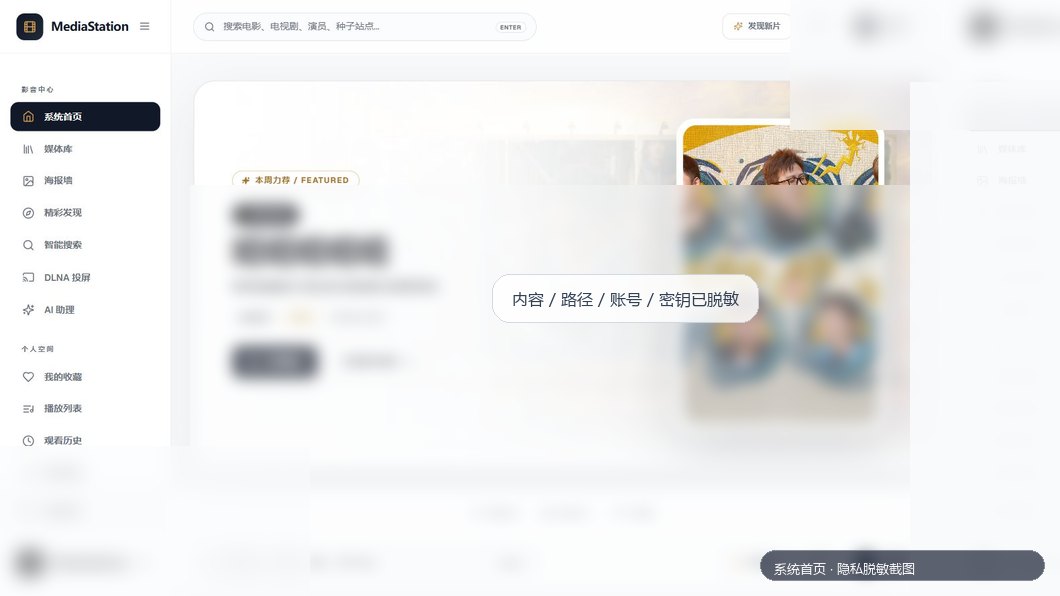
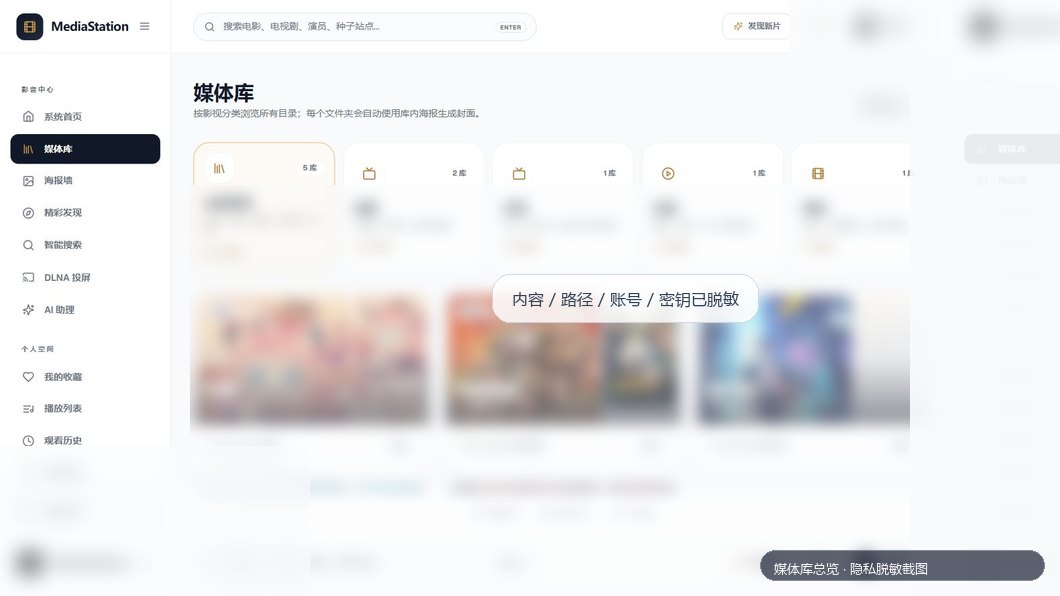
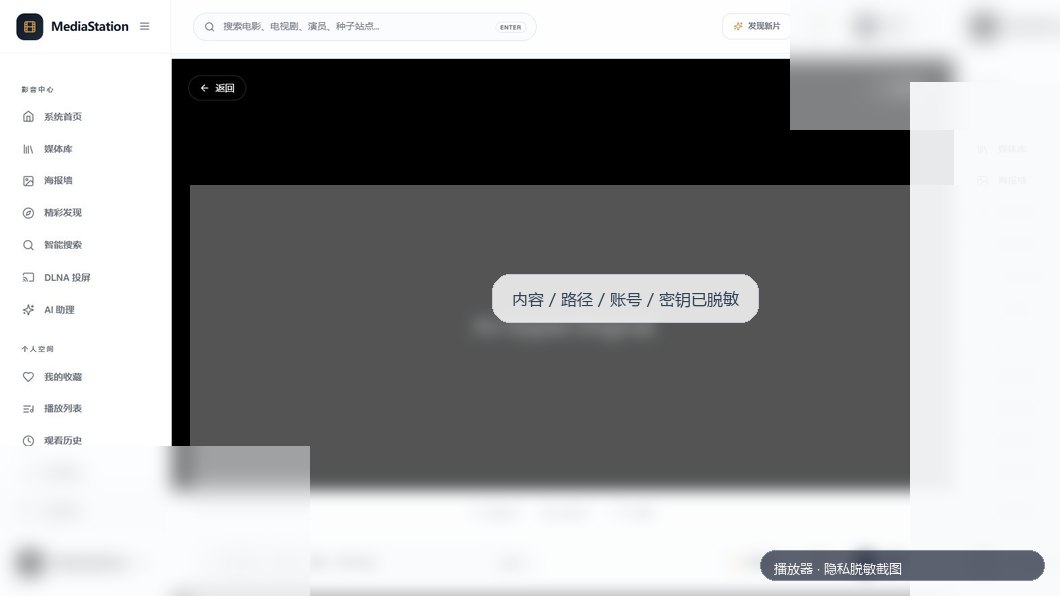
Preview
| Login | Home |
| --- | --- |
| | |
| Libraries | Player |
| --- | --- |
| | |
---
## Development
Regular users should use Docker. Developers can run:
```bash
go run ./cmd/server
```
Frontend:
```bash
cd web
npm install
npm run dev
```
Tests:
```bash
go test ./...
cd web && npm run build
```
---
## Community and Friends
- Telegram group:
- NodeSeek: [https://www.nodeseek.com/](https://www.nodeseek.com/)
- LINUX DO: [https://linux.do/](https://linux.do/)
---
## Donation
If MediaStationGo saves you time, feel free to buy the author a bowl of noodles.
---
## Star History
---
## License and Non-Commercial Statement
This project uses `GPL-3.0` as its base license. See [LICENSE](LICENSE).
The maintainers also state and request:
- The project is intended for personal learning, home NAS, self-hosted media, non-commercial research, and community collaboration.
- Without explicit written permission from the author, do not use this project or derivative versions for commercial resale, paid hosting, paid SaaS, pre-installed commercial devices, closed-source redistribution, or other profit-oriented commercial use.
- For commercial cooperation, enterprise deployment, custom development, integrated redistribution, or commercial authorization, contact the author first.
- If there is any interpretive difference between this README and the formal `GPL-3.0` license text, the code license is governed by [LICENSE](LICENSE); commercial usage should additionally obtain author permission.
---




 |
|  |
| Libraries | Player |
| --- | --- |
|
|
| Libraries | Player |
| --- | --- |
|  |
|  |
|